“Right of way” in fencing is the rule that decides which fencer’s touch scores first when both fencers hit at about the same time.
- Fencing is fast, so officials use “right of way” (often called priority) to determine who is on the attack.
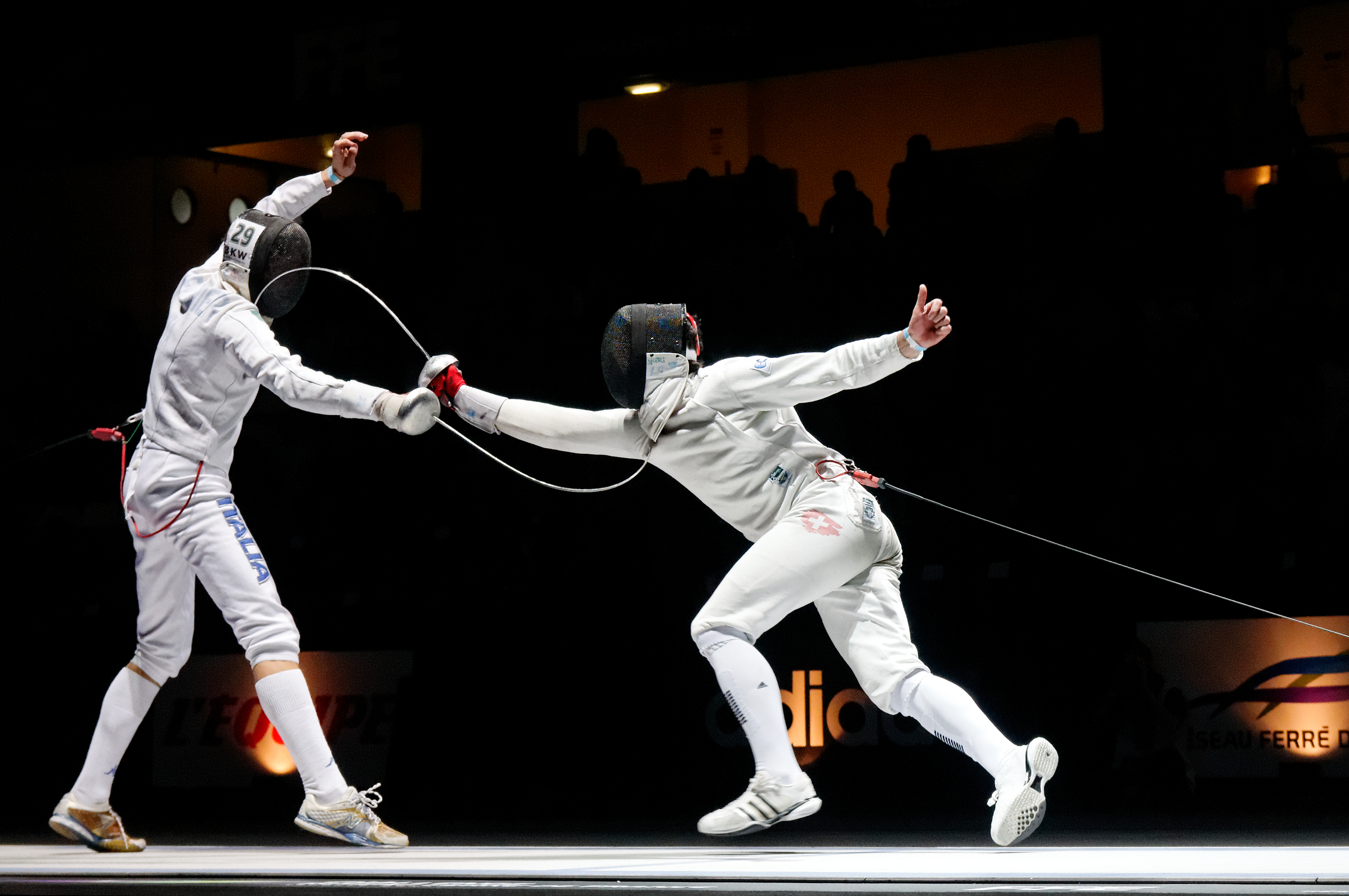
- When both fencers hit each other nearly simultaneously, that is called a double-touch.
- Only the fencer who had right of way scores from a double-touch.
- Right of way is lost by losing initiative (e.g. walking backward, no longer on the attack)
How right of way is determined typically
Right of way generally belongs to the fencer who is considered to be:
1) Attacking
Typically the person who initiates a valid attack (for example, lunging/advancing with correct fencing action).
- If their attack is judged to be the real, ongoing action, they usually have priority.
- If the opponent tries to score by attacking or countering, the timing matters.
2) Defending successfully
In many situations, a defender can gain the advantage by:
- Stopping the attack in a valid way (e.g., with a legitimate parry/disengage sequence, depending on the situation).
- Examples are parrying the opponents blade or moving out of range of the opponent’s attack
- Suddenly, the defender has right of way
3) Counter-attacks and ripostes
- If the opponent parries or blocks correctly, the initiative can shift, and then the next valid action may create new priority.
- Note: this means that, for example, if you parry the opponent but walk backward, you don’t have right of way.
- Different weapons handle this with slightly different timing nuances, but the principle is the same: the referee decides who had the initiative when the touch happened.
Priority outcomes in practice
When the referee believes the touches are simultaneous/very close:
- Right-of-way fencer = gets the point
- No-right-of-way fencer = touch does not score (often lights/score may be shown in a “double-touch” situation, but the official result will apply right-of-way)
Special note: Epee is different
In foil and sabre, right of way is used.
In épée, there is no right of way:
- Both fencers score from a double touch.
Quick example (foil/sabre)
- Fencer A launches an attack.
- Fencer B touches while A’s attack is still considered valid.
- A’s attack gives A right of way, so A’s touch scores and B’s touch is negated.