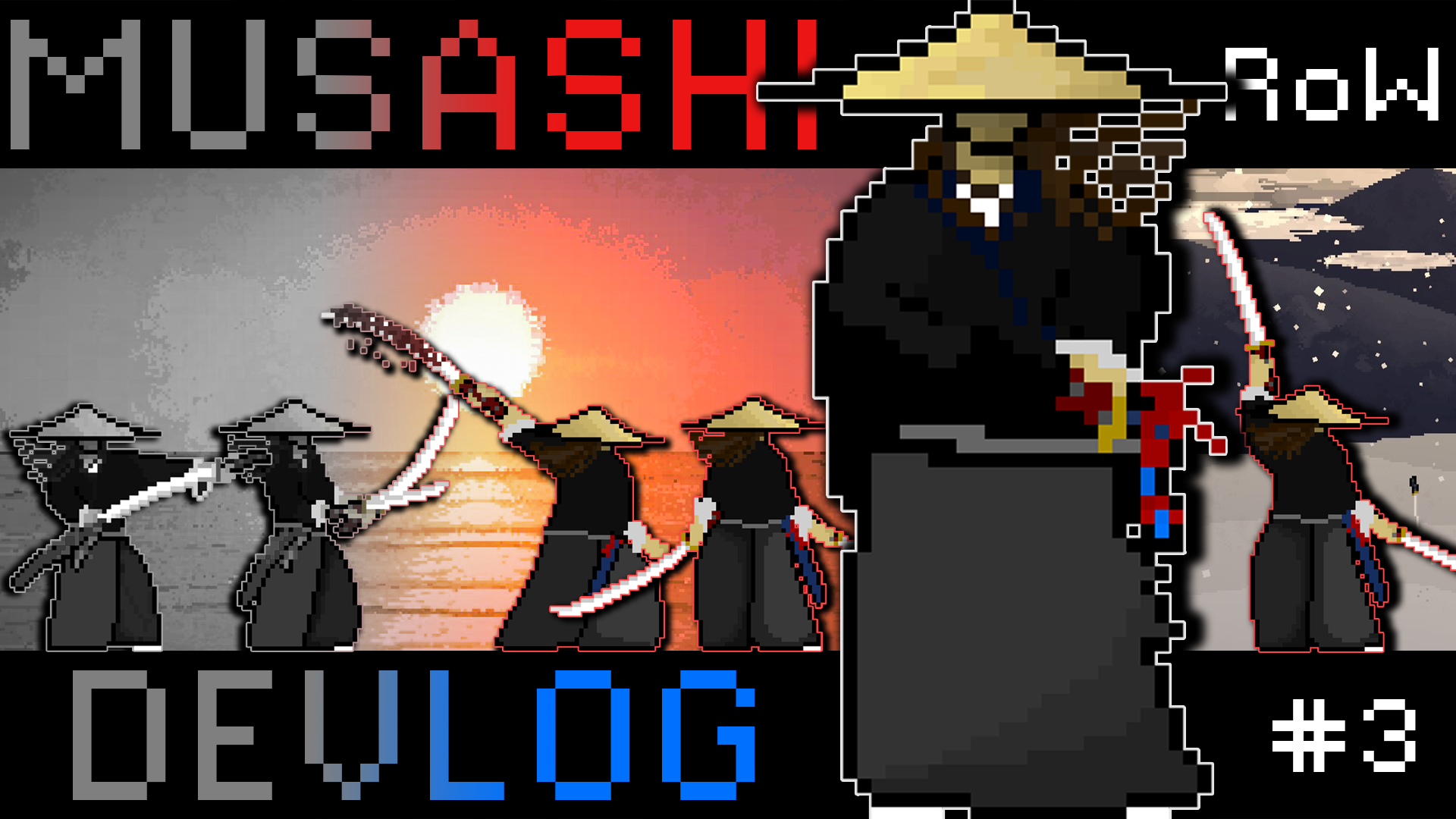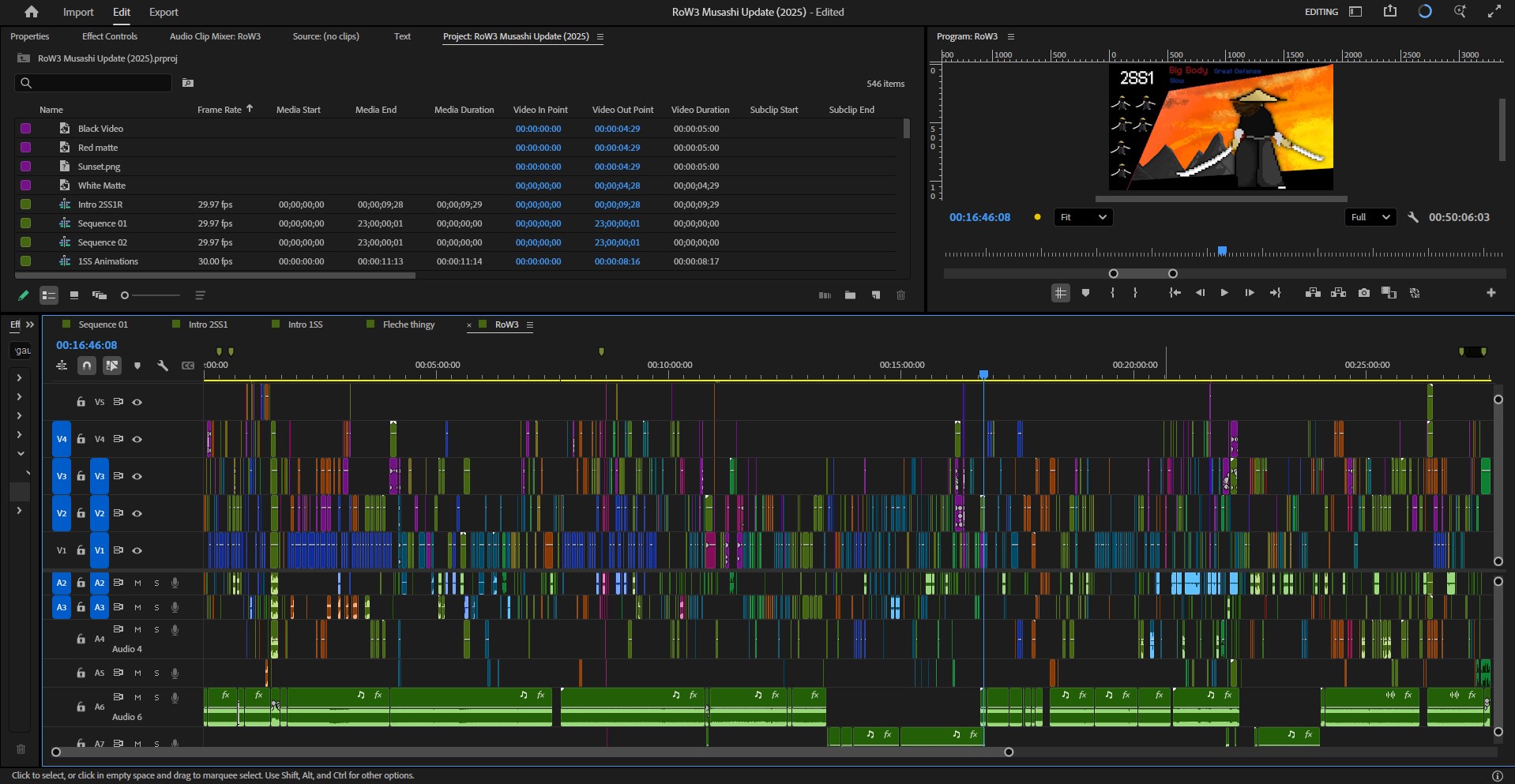
After writing a script, about 20% is deleted. Then, after recording voiceovers, about 30% is deleted. Trust me, videos are really trimmed down–the following script isn’t nearly as much as I wrote, and definitely nowhere close to how much work I put in.
The following is copied-and-pasted from my huge Musashi Devlog file. Italics designate things to edit/show on screen.
6414 words.
Left Out
- Musashi was a rekka character
- RoW3 Storage (Intro):
- Modern fighting games are too combo focused. PUT THIS IN THE “MAKING MY GAME UNIQUE” VIDEO
- Reaction to musashi tier (in tournament project)
- Snowy field
- Susanno from BlazBlue
Remember
- Say stance, not state. They are different.
- “really I made four characters for this one video”
Table of Contents
- Intro
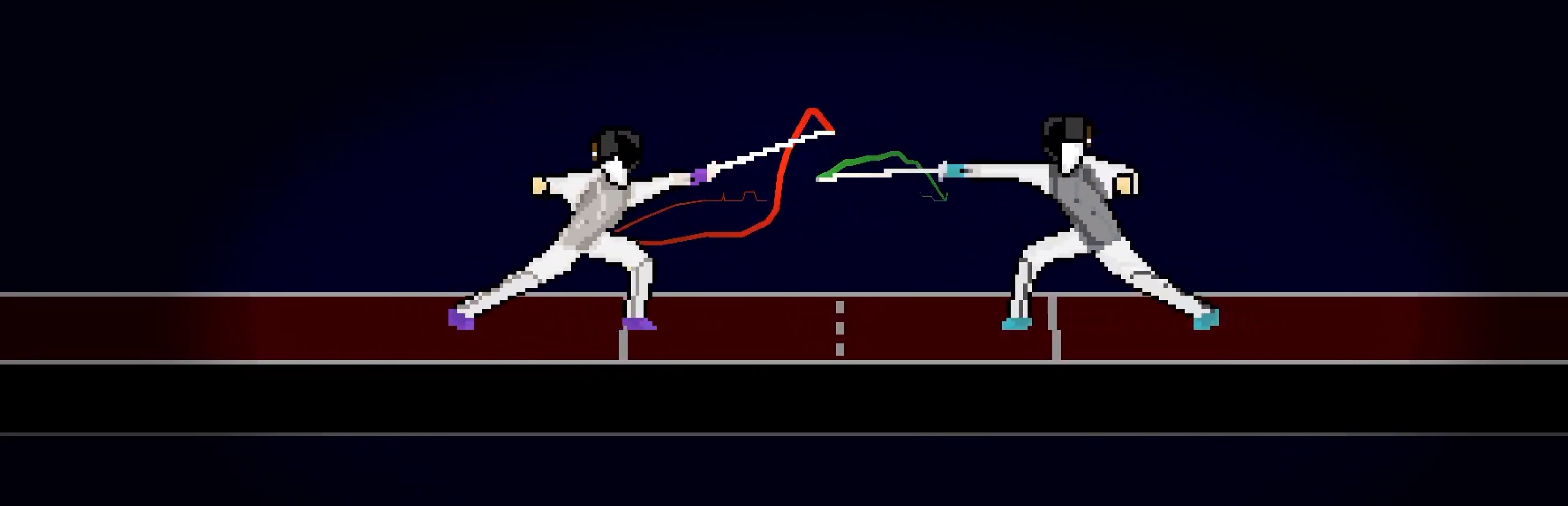
- Despite my fighting game being based on fencing, NO ONE cares about the fencer.
- Despite spending a whole summer on that character, NO ONE even plays him.
- Same with the poster child of the whole game!
- Noooo, everyone
- I like samurai movies, so I made Musashi (SHORT! more on this later)
- Musashi is the favorite/strongest
- This is how Musashi works he was planned to be simple with moves that draw different swords. cant even move during 1SS
- But, Musashi SHOULD be a stance character
- Explain stance characters
- But, it’s not that simple.
- This is how my game works
- Knowing this, here is what Musashi will become all sword styles shown with their moves in a table. Later, show influences for each move, but not now. Viewers dont really care as much bout samurai movies
- Finally, this is crucial with Musashi: You don’t always want to switch stances. You may prefer one and stick with it, as each is fleshed-out enough to be its own character. Or, moreso, you may want to switch to adapt–adapt to the stage, the opponent, their character, their playstyle, anything. opponent spams attacks? Switch styles. Really, Musashi might be the most complex character I’ll ever add, just because he is completely up to interpretation. show different playstyles simulatenously, all stacked horizontally. Scroll down slowly once the screen is filled, showing more. But, they get swiped away, as they are spoilers. After all, that was the whole point of the samurai fighting style he invented. More on the balancing and fighting style later. Let’s see what I added first.
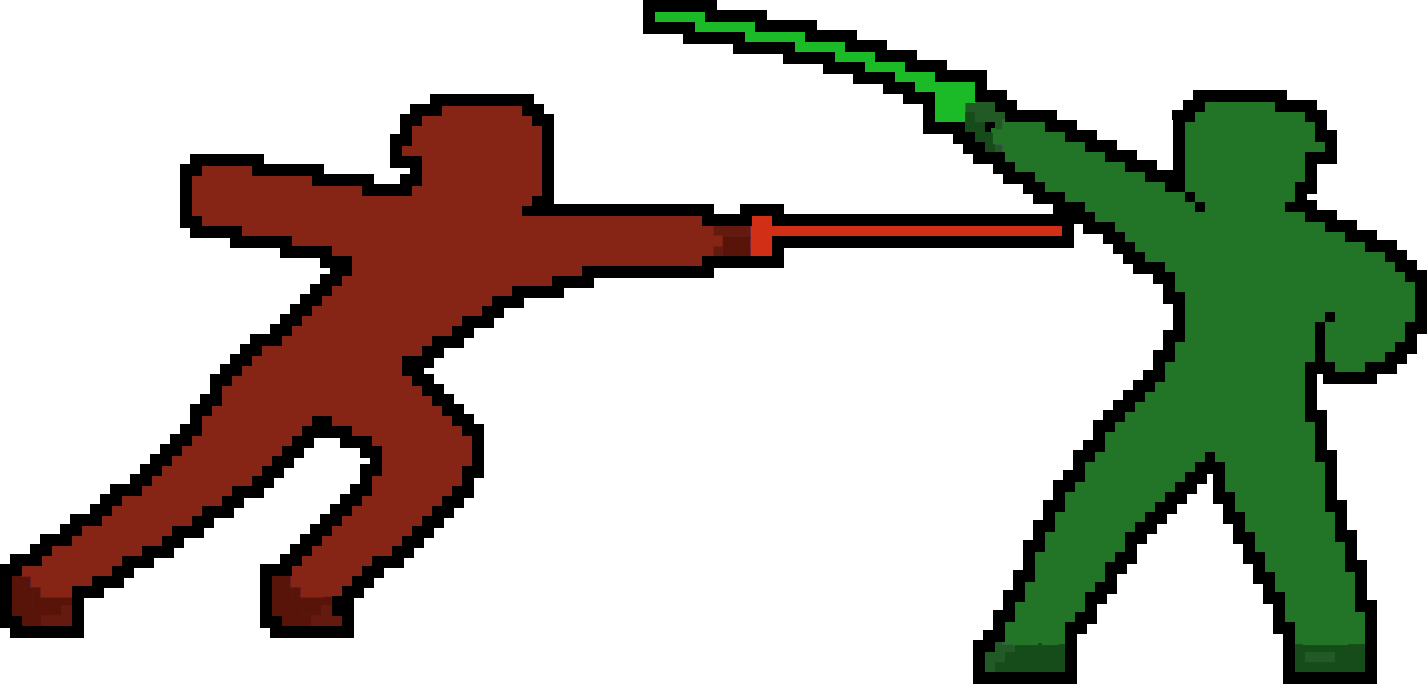
- A year ago, I spent an ENTIRE summer adding a fencing character to my fencing-based fighting game. But, despite him being THE ENTIRE POINT OF MY GAME, NONE of my friends chose him. Every single person gravitated towards that one-off samurai character, Musashi.
- Who could blame them? He was the coolest, he was the fastest, he was the strongest, he was the character who got his own TIER on the tierlist.
- But guess what? He only had 2 moves. That’s it. He could slash, and slash… again. He was NOTHING, yet EVERYONE chose him over the other characters.
- And that didn’t sit right with me. I put so much work into the fencer, just for him to be ignored! So, of course… make it sound sad like u gave up… I decided to… work even harder. For the last 5 months, I’ve worked on this one character so he could be deserving of all that love. Even worse, he has more than the other characters COMBINED. Not to mention the three stages and entire system mechanics made just for him.
-
I’m not here to explain my game. Because, honestly, it’s no longer what it once was. It used to be described as a “fencing-based fighting game”, but now, if it’s going to be based on anything, it’s a samurai movie. super cinematic
- Musashi is based on, well, Miyamoto Musashi, the legendary ronin. He founded his own sword style, based on being fluid and taking whatever means necessary to win.
- I’ve read his book, the book written about him, and the manga written about him, and let me tell you, this guy was CRAZY.
- This man taunted his rival for years, and when they finally dueled, Musashi showed up late. As in, half a day late—to the most notorious duel in Japan’s history! And, when Musashi finally arrived, he took an oar—one he used to paddle there—, carved it with a sword, and instead of using said sword, he used the wooden oar in his duel! Despite how dumb he looked, he spouted some wisdom like “I see you’ve already dropped your sheathe, meaning you won’t live to see tomorrow.” So stupid, but guess what? Musashi WON!
- With a wooden oar, he hit a 360 inverted jump attack on the best samurai there was, and that was enough for me. Ever since reading that book show Musashi, I became infatuated with samurai media. References to Kurosawa films, like Seven Samurai and Yojimbo, take up both my room and my game.
- And, as a fencer, these naturally went together—I mean what other 15 year old cuts bamboo with a katana? show video
- I’ve developed my indie 2D fighting game on the basis of both fencing and samurai movies: it takes just one hit to win. In fencing, one small touch is enough. In samurai duels, one small mistake is enough.
- Other fighting games seem to miss this. I’ve always found it strange how you could do a huge combo or super attack, and the opponent is just fine, only missing a part of their “healthbar”. That’s so weird to me! There’s often no huge consequence to getting hit, so the pressure disappears, and the fighting is just for show. The “fighting” in fighting games merely becomes a medium for showing off hours of practice in training mode. Modern fighting games practically encourage you to practice combos offline for hours, just so you can lower your opponent’s “healthbar” a bit more. The emphasis is no longer on those intense moments, in which you and your opponent are nearly within reach, but one wrong move could ruin either one of you.
- That’s the appeal of fencing, that’s the appeal of samurai movies, that’s the appeal of my game, Right of Way.
- The name “Right of Way” comes from fencing, in which whoever is on the offensive has priority. Then, if both fencers hit eachother simultaneously, the one with priority gets the point.
- In fact, this rule originates from real duels, as swordsmen would be cautious and preserve themselves during an attack.
- Even moreso, this rhythm is the core of samurai duels, making a samurai perfect for my game. As Miyamoto Musashi wrote, “#TODO quote about fluidity”.
- Finally, Musashi taught and lived his sword style, the use of two swords as a means to adapt to opponents.
- Therefore, throughout this video, the goal is for Musashi to be fluid and adaptive. Before, he was a “rekka character”–rekkas are moves that allow you to choose a follow-up attack. Think of them like a flowchart.
- It made sense before, but now, Musashi is meant to be much more adaptive. Henceforth, he is now a “stance character”.
- This is an archetype in fighting games in which a character can enter different stances, each having its own unique moves.
- So, to adapt, Musashi players can simply switch to another stance. Just like the real Miyamoto Musashi taught.
- Finally, this is crucial: You don’t always want to switch stances. You may prefer one and stick with it, as each is fleshed-out enough to be its own character. Really, I made 4 whole characters for this one video…
- Or, you may want to switch to adapt–adapt to the stage, the opponent, their character, their playstyle, anything. Really, Musashi might be the most complex character I’ll ever add, just because he is completely up to your interpretation as the player. show different playstyles simulatenously, all stacked horizontally. Scroll down slowly once the screen is filled, showing more. But, they get swiped away, as they are spoilers.
- Opponent keeps retreating? Switch to “2 Sword Style” and rush in, then utilize a multi-hit attack.
- Opponent keeps rushing in on you? Switch to “2 Sword Style Back”, and take advantage of the huge range, quick jab, and defensive parry.
- Opponent maintains distance well? Switch to “0 Sword Style” and use ranged attacks for mix-ups.
- Opponent doesn’t really matter, you just want to play a strong well-rounded character? Switch to “1 Sword Style” and have a balance of everything.
- 1SS
- Ideally, its movement is slower, being its biggest downside.
- Wait, it has no movement–it can’t even walk yet.–remember, it was once just a rekka, not even a real stance.
- I made a walking animation, finally, after a year. Funnily enough, I originally didnt plan Musashi to even be able to walk with his sword out!
- And that was actually the second thing I did. The first was to create this: Backslash into 2SS.
- Here’s a spoiler of 2SS’ idle, because too many clips include it, so at this point, I kinda cant avoid it. At the time of making these moves, 2SS didnt exist yet. BUT, MORE ON THIS LATER.
- During this backslash, the “wakazashi” gets drawn. This is the core of Musashi’s “niten ichi-ryu”. explain miyamoto musashi stuff. expand upon the influence
- Balancing-wise, this can be seen as an advantage, or even a downside. THIS SECTION WILL EXPLAIN A LOT OF FIGHTING GAME LINGO/MECHANICS
- The main upside is that it’s a two-hitting attack, meaning that the opponent has to parry twice if within range.
- Even if the second hit falls short, the initial overhead slash has a huge hitbox, and in my game, all it takes is one hit to score.
- In addition, the unsheathe causes the animation to have less endlag frames explain/show what that is, as once the wakazashi is swung, Musashi quickly enters his 2SS stance. So, the time from attacking to neutral is very short, which is great.
- However, tone shift this is forced, not optional. So, if the first hit misses, you are stuck in an animation that produces ANOTHER hitbox. If the opponent catches up after you miss, they can parry your second hit and land a riposte. or…… your opponent could just time a big attack. sho big kick
- And, you can’t spam this move. You use it once, that’s it, now you’re in a different stance.
- Remember, with Musashi: You don’t always want to switch stances. It is completely plausible that a player would prefer one or two stances, and remain in those for most of the game. For example, what if you pushed the opponent to the end of the stage, and suddenly you are forced into a stance that focuses on speed but has a bad parry-riposte? The opponent could take advantage of that!
- Finally, this attack retreats, therefore it loses right of way, but the complexity of that is left for a different video.
- wait, this also loses right of way, so write about that, too.
- That backslash moves backwards, so I made a move that moves forwards.
- This is an upwards-ish slash, that aims for the middle. It serves as a strong bait-and-punish, as Musashi slides back, charges the attack, then launches forward. Its range is great, but the big downside is its long, telegraphed startup.
- For a long-range poke, Musashi got a lunge attack. It is a great all-rounder move, with enough range without costing too much startup nor endlag. It can be parried, yet far enough for a riposte to fall short.
- However, he is still… slow. He has great pokes slash, lunge, etc., but what if the opponent just… walks backwards?
- So, against my own wishes, I gave Musashi… a jump.
- The jump has its own launch animation–cool, right? therefore, the actual airborne jump is delayed a few frames from when the player inputs it.
- And, it has a landing animation, which disables inputs for a few frames. So, jumping can be risky!
- But, the benefits?
- I made an air attack for Musashi. It has low startup AND a great hitbox.. Also, here’s some forbidden tech: if you input it near when you land, it has little endlag–only being the landing animation.
- Also, it… uh… could be spammed during the jump, which… not really fair. I did fix this immediately!
- Finally, it gives Musashi a boost in the air.
- This move enables Musashi to maneuver vertically, AND at the threat of the opponent. So, how can you counter it?
- I made it so that Musashi could not change directions in air. Usually, in anime fighting games, jumps are fluid, even including airdashes. show Sho manuevering in air But, in more traditional fighting games, such as Street Fighter, once you jump in a direction, you are stuck in that direction.
- Therefore, it’s best to not directly challenge Musashi’s jumps, but to instead back up and punish, or rush in and parry.
- Intermission 1.0: Snowy Field
- Before covering 2SS, I just have to show you a map I made.
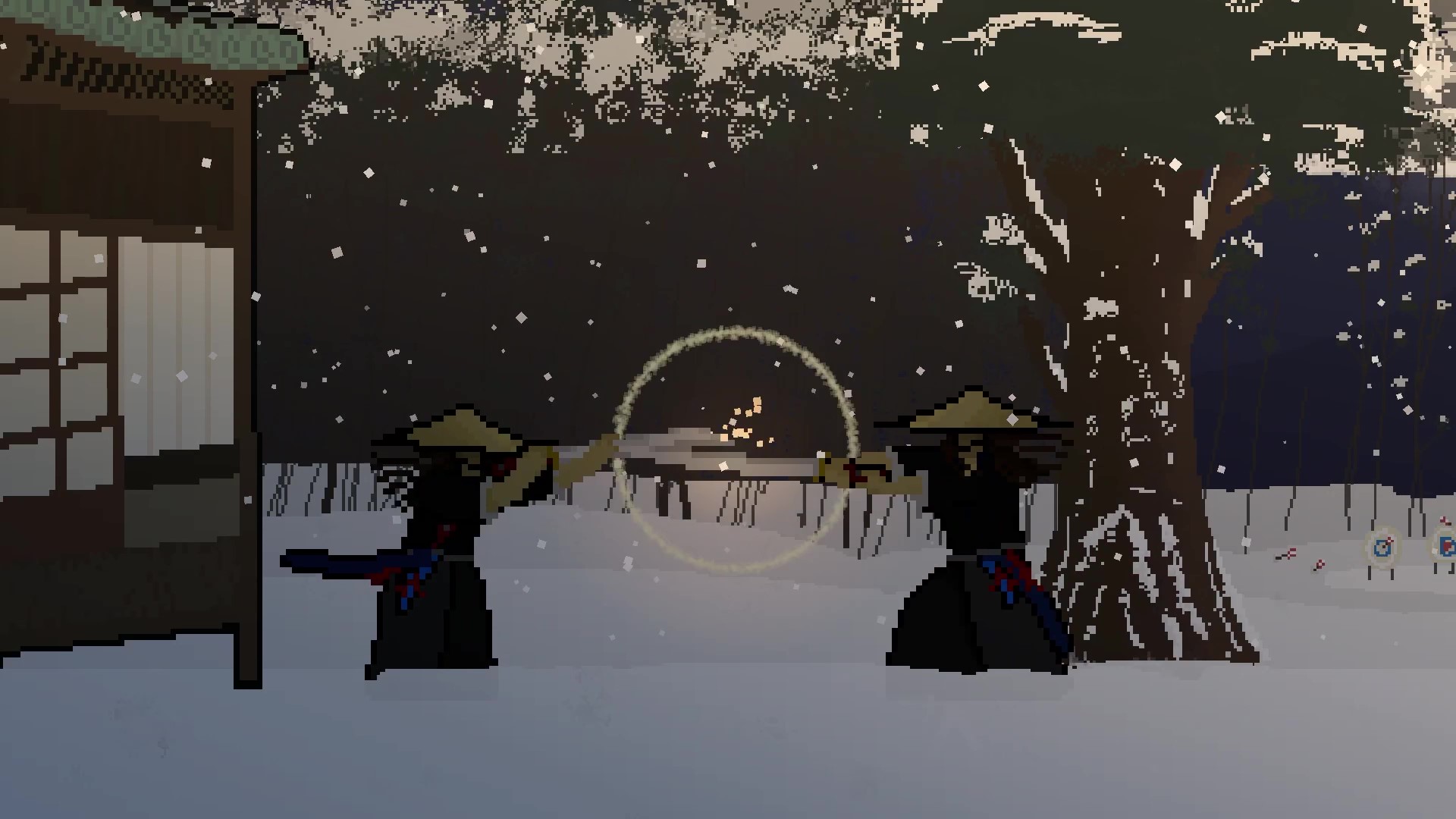
- This is “Snowy Field”, for lack of a better name. Really, it should be called “#TODO”, because it is based on #TODO from the novel Musashi, by Eji Yoshikawa. All the way back in my first devlog, a whole year ago, I cited this exact book as the inspiration for the ENTIRE Musashi character. I read this huge book a few years ago in 9th grade, and it stuck with me. My favorite part was the battle with #TODO’s martial arts school–I remember how the bad guys looked all over the snow for Musashi, when suddenly he jumped off the roof and swung at them! Remember, this guy was crazy.
- So, this stage is directly based on that fight.
- I drew this Japanese-style house, which I’m quite proud of. The shading, colors, panels, shingles… beautiful.
- Of course, a forest in the background.
- And, I drew both archery and dummy targets. The dummies are pretty cute, so I felt a bit guilty drawing arrows in them.
- Finally, for the first time ever, I split up the layers into different groups, to create a “Parallax” effect. That’s the visual effect of the background moving slower than the foreground, as if the background truly was far away.
- In my horrendously ugly tall grass stage from a year ago, I had grass infront of the player, but that was the extent. Now, there are multiple layers of differing parallax, which adds gorgeous depth to this stage.
- Anyways, knowing all that, after my first rendition of this stage… I… hated it. clips of me hating
- Eventually, I enlarged it to a new aspect ratio and canvas size, which would later become the standard for my maps.
- The smaller pixels definitely saved this stage from being deleted forever.
- And, what really saved me: I found my old drawing tablet. After years, it was finally time to dust it off and save this update… gets really high speed for all the following
- I deleted half the forest, then rehauled what remained. Even now, I’m iffy on it.
- Also, that random hut from earlier? Yeah, that’s gone, and replaced with swords in the snowy hills, as if it’s a forgotten battlefield.
- Then, I added clouds to the sky.
- Next, I decided to experiment; I tried out Godot’s lighting and occluder systems.
- Finally, I tried to draw snow falling, but it looked horrible. So, for the first time ever, I tried Godot’s particles system. And, just like that… Doesn’t that look amazing? Especially since the snow is also split into parallax layers!
- The former is inspired by the lighting I had to employ in my 3D games, a Call of Duty Zombies knockoff and the best powerup-based rougelike party game ever, “You Only Have Legs”. I made that for a school club competition within 2 days, and won bronze at regionals. You’ll watch their respective videos elsewhere on this channel.
- After all that, the stage looked great.
- ***Intermission 1.1: Camera LEAVE THIS OUT, IT IS TECHNICAL
- By the way, this whole time, the camera zooming you’ve seen has been smooth, right?
- Well, that was programmed while working on this update.
- What I wanted was for the camera to zoom in slower th98e closer it was to its goal. For example, if the camera was zoomed out to, say, 2 times, and it had to zoom in to 2.5 times, it would initially zoom in quick but gradually slow down.
- This was important because, before, when a player lost or gained right of way, the camera would bolt over to them. Now, it slowly moves slash zooms, but still zooms out quick if the players suddenly move far apart.
- As you can see, figuring it out was horrible, and it drove me insane!
- I wont go in depth, but here it is! This is the code to “interpolate” the camera zoom. It follows Godot’s premade easing curves, and the speed is fully customizable as a single variable.***
- Intermission 1.2: Clashes
- There is one more thing I HAVE to cover.
- For the first time ever in my game, attacks can clash.
- I created what I call a “ClashBox”. hurtbox, hitbox, clashbox!
- It’s actually a line, not a box, so that it can detect where it intersects with other clashbox lines. When they intersect, both players take knockback.
- However, it only appears for a split second at the start of active hitbox frames. Basically, there is a slight moment that your attack can clash. Also, this only happens to swords, as fists cant really, well, generate sparks.
- And, it turns off hitboxes for the rest of both attacks.
- Thus, the clashbox acts as a shield. It can stop you from getting hit–however! You don’t always want that, because your attack would also be canceled, obviously.
- Therefore, this should add some complexity to the game. Usually, you may want to relent attacking, in favor of baiting an attack for a whiff punish. Yet, you may want to go for clashes at times that parries are risky, or during times that you are on the advantage and want to pressure with attacks.
- After all, less knockback is applied to the player with right of way, and more to the one without it. And, as per fencing rules, if you attack but miss, you lose right of way. So, do you want to give up right of way for the chance to push the opponent to the end?
- That’s a lot to think about, I’ll let you be. I’ll make a more in-depth Right of Way strategy video later. However, if there is one takeaway, it’s that…
- MAKING PARTICLES IS WEIRD!
- This was my first time ever making particles that, i dont know, look cool? Yeah, the snowy stage had snow, but these sparks particles gotta explode! They gotta glow! They gotta go in different directions and pop and swirl and fall and glide and fade away!
- Fortunately, I am a kid with a lot of time on his hands. who also procrastinates a lot and has a million hobbies to tend to So, after a lot of hard work on these system mechanics, the game is looking and feeling better. Now…
- 2SS
- Back to Musashi.
- 2SS is characterized by its pressure. It is a “rushdown”, the most popular archetype in fighting games. Not only is the walk faster, but 2SS also offers dashes. This ability to quickly close distance cannot be found elsewhere in Musashi’s kit. YET
- Even moreso, the pressure comes from multi-hit attacks. jab-slash Remember the backwards overhead slash from earlier? It hit twice, but not like this! Before, there was enough of a gap for the opponent to react. Now? The opponent HAS to parry twice–they can not risk interrupting this attack! The hits are so close to eachother that a “frametrap” is created. contrast how the overhead leaves a large gap to interrupt, but this doesnt
- In fighting games, a frametrap is a miniscule gap in-between attacks. It is usually around 3 frames, which gives the opponent enough time to spam an attack, but if they do, the gap is so small that they get hit during it. Basically, think of it as a bait for opponents who spam attacks up close or after parrying.
- I drew this huge idle animation and these walk animations. The idle animation itself is already a huge improvement from my original art for this game. show OG art Seriously, throughout this video, it’s clear just how much my art improved. *This video is NOT in chronological order, but trust me, you can tell which animations were made last. show the best animations
- Thanks, Eji Yoshikawa, couldn’t have done it without you.
- Then, I drew a dash animation. Beforehand, dashes could only be inputted by the stereotypical fighter, Sho. The fencer’s dash is actually a step-forward, which leads into other moves. Now, 2SS enables the player to quickly close or open distance with little risk.
- The backdash is a separate animation, and is technically faster than the forward dash. This is because it ends sooner, giving a slight edge to players who want to bait an attack, quickly retreat, then punish.
- However, all this amazing rushdown pressure from 2SS has to be balanced.
- So, the 2SS parry has less active frames, and a lot of endlag. Basically, the smaller parry window makes this stance riskier, with less forgiveness for a mistimed parry.
- Even worse, the riposte is lethargic and punishable!
- Not to mention, its sprite animation is just a copy of the 1SS lunge…
- In conclusion, 2SS offers a risky playstyle. It challenges you to close the distance and apply pressure up close–otherwise, the opponent could take advantage of the risky parry and long attacks.
- That’s cool and all, but unfortunately, I’ve hidden so much from you. Let’s tackle my best stage yet…
- Intermission 2.0: Ganryu Island
- Miyamoto Musashi had a lot of media made about him, largely thanks to the aforementioned novel.
- For example, the “Samurai Trilogy” starring Toshiro Mifune, who is a legend leading many Kurosawa films. Fun fact, Musashi’s character selection screen is based on a shot of Mifune! Anyways, fanboying over,
- The final movie of this trilogy is called: “Duel at Ganryu Island”
- And guess what I drew for Right of Way? Ganryu Island. Oh, you might be asking why. I drew Ganryu Island from Duel At Ganryu Island just so that you could duel… at Ganryu Island. Woah.
- Anyways, spoilers for Vagabond fans, but, at the end of the Musashi novel… Miyamoto Musashi and Kojiro Sasaki, the two best ronin of the time, dueled on that island. Well, if that’s a spoiler, you are #TODO years late, cause that is a genuine historical fact…
- Inspired by the most important event in Musashi’s life, I suffered to painstakingly draw Ganryu Island.
- At first, it was this mess
- Then, it became this colorful canvas of vomit
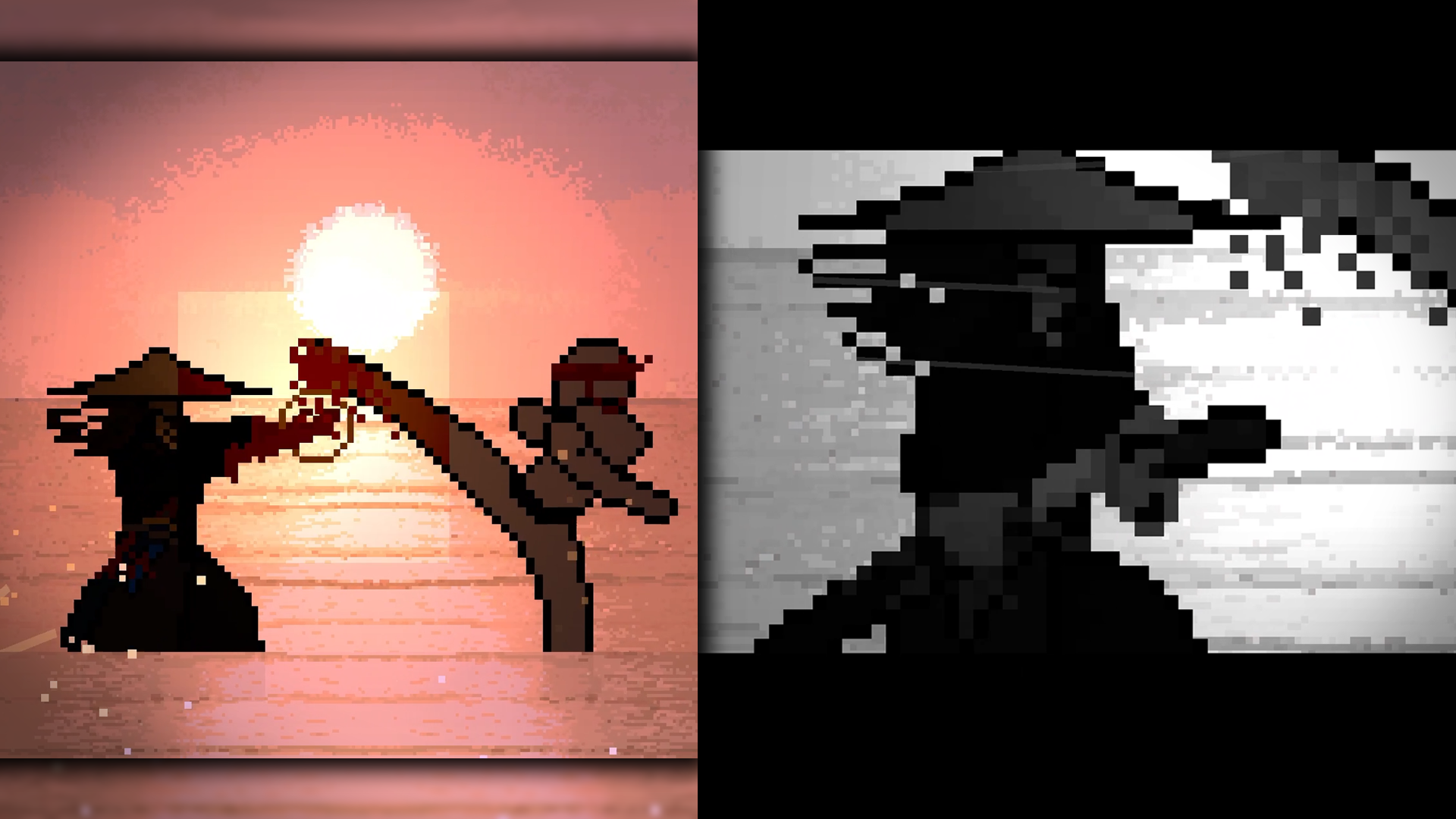
- I was severely struggling to draw a sunrise, so I rewatched Musashi Samurai film 3 funny clip from movie, and at the end, screenshotted the duel. Because this duel was, unfortunately, a faked movie scene and NOT a real fight to the death, the lighting changed throughout it. So, I had a large range of colors to choose from.
- Color picking the screenshot gave me these really pink colors, which is confusing. I swear that the screenshot is not nearly that pink, but when I draw it, there isn’t even any yellow. But, honestly, I like it.*
- The waves were also separated into parallax layers, but even moreso than before, making it look much smoother! Actually, while we’re talking about the waves, cmon guys, I’m so proud of this. Dont they look beautiful?
- The ground of this stage gave me a lot of trouble. I tried making it look like sand, but left it brown/reddish for a while.
- Eventually, I made the sand lighter, and fixed the poor shading. it was upside down
- And, I animated waves to drift onto the sand. These waves took way too long to draw, much longer than I’d like to admit, but the goal was to have some kind of water infront of the players’ feet–similar to the snow from the first stage.
- To make it look a bit more like, you know, waves, I experimented with particles again. This time, one particle simulator was set across all the waves, as if it was generating bubbles. Then, I had two sets of particles generate whenever the waves crashed in the sprite animation track.
- Sadly, I did end up deleting all of this. However, I’m glad I did it, because it taught me how to do… sanjuro blood well… you’ll have to wait and see.
- I indexed all the colors from the stage, then manually changed some of the colors. It was too… weird before. Now, it uses more of a uniform color palette.
- Eventually, I bit the bullet and hand drew the rest of the ocean, including what would be infront of the players.
- It is slightly transparent, so it appears as if you are actually fighting in the water, as Musashi and Sasaki once did. text from book about how kojiro threw his sheathe in the water, and that’s how musashi knew he’d win
- Finally, I drew mountains, and that was it for this beautiful, cinematic stage.
- Intermission 2.1: bugs
- I forgot to show you guys something… clash penis thingy
- making the clash box didnt go so well.
- A lot else didnt go so well. show buggy stuff
- Coding is hard.
- Let’s talk coding.
- It was difficult to tell the game where the sparks particles should go. Essentially, I couldn’t figure out how to turn the ClashBoxes into code, and find the edges of the shapes from there. I tried multiple kinds of shapes for the ClashBox, but eventually settled with the line, as that was the only thing that I could program with. The rest wouldnt let me find the edges.
- And, a lot of the documentation straight up didn’t work, or required things that I just don’t understand.
- Currently, when two clashboxes intersect, the code… uh… I forgot. Honestly, I think this was the one time I copied code off the internet and, moreso, forgot to change or even interpret it. I did write the “return Vector2” code, and you know I did, because I left a to-do note detailing why my code sucks!
- Well, it’s not that bad. Basically, 90% of the time, my code runs, and when it does, it just finds the midpoint of player one’s clashbox. I quite literally just used the midpoint formula and called it a day. As I write this, I came up with a much better idea–is that a good or bad thing?
- Anyways, moving on, random bugs go here, in this section.
- 2SS1
- There is one more move I made for 2SS: a lunge that transitions into 2SS, but with the back turned. This, originally, was going to be its own little thing; Musashi would lunge, turn, and swing his katana to turn himself back around. But, I drew the turned-around sprite, and…
- This had to be its own stance. It was just too cool.
- Before we move on, let’s look back at that 2SS lunge into 2SS1. Normally, it takes a second to make sprite animations look fluid in Godot. But, when I inserted the “add velocity” functions, it immediately turned out like this.
- I have not changed this animation since. Usually, I have attack ideas that I refuse to draw, just because they involve Musashi fully rotating around. But, I took a leap of faith on this one, and it came out perfectly.
- Yet, it conjured 2SS1 into existence. This meant my work was far from done.
- I drew this seamless idle animation, which made 2SS1 official.
- Also, I gave 1SS an unfinished taunt-like animation, which enables the player to skip 2SS and instead enter 2SS1. I dont wanna animate Musashi turning around…
- Next, it needed a walk animation. However, should it be slow or fast? Well, what even is 2SS1?
- So far, Musashi fills the following archetypes: Shoto (all-rounder) and Rushdown. We’re missing the “Iaido” archetype, but that HAS to be saved for later, when I finally tackle 0SS. flash cut wind sfx fades to black
- So, 2SS1 will fill the… big body one-shot committal footsies bait-and-punish role. Uh. Yeah.
- Okay, this one is difficult to explain.
- Let’s look at Nagoriyuki in Guilty Gear Strive.
- This vampire samurai guy is a “big body” character, meaning he is slow and has large, committal attacks.
- However, he is classified ingame as “one-shot”
- This is because, well, how do I put this? If he hits you… stupid nagoriyuki bs, rage… it’s a one shot.
- Basically, he trades off movement and health for, well, your health.
- Even ignoring the whole samurai thing, 2SS1 is similar. I actually used Nago’s jump as a reference for 1SS
- 2SS1 trades off movement for large attacks, which can be horrifyingly fast.
- However, just like Nagoriyuki, Musashi can commit to a risky, but fast, dash.
- His walk is slow, and perhaps has non-uniform speed, which I’m still deciding on.
- He has a dash—oh. Oh. That… that is ugly. I should… probably fix that. At the time of writing this script, I haven’t yet, so we’ll see!
- He also, uh, doesn’t have a backdash, at the time of writing.
- Ok, well… now he does! I hope…
- These dashes are far more committal than simply walking, but they offer great bursts of speed.
- Speaking of speed, Musashi has a wakazashi jab. This is extremely fast and noncommittal, allowing safe pokes to help scare the opponent into a comfortable distance.
- In fact, the parry is almost the same animation, but with slightly different frames and VFX.
- This parry is amazing, giving Musashi much-needed defense as he lacks safe maneuverability.
- And, it’s hard for the opponent to discern whether it’s a jab or parry, which players could abuse.
- Unfortunately, large attacks are physically difficult to implement. The wakazashi is short, meanwhile the katana is on the other side. If Musashi were to swing the katana, he’d have to switch stances into 2SS.
- Honestly, that would be cool, but I don’t want to draw that.
- This update has taken me too many months. I’m sick of drawing this character.
- But, Musashi came to me in a dream, and I witnessed something.
- Stereotypically, in samurai fights, one duelist has his sword raised.
- That’s it.
- Musashi has to raise his katana to his ear.
- I drew exactly that, gave it an entire idle animation, fixed the ugly arm, and…
- Wait.
- It has its own idle animation.
- Is this seriously ANOTHER stanc—??? cut off by stance screen
- 2SS1R
- “2SS1R” is categorized by its complete inability to move, in favor for fast, huge attacks. said like a bored guy reading a script
- This slash shown on screen has a large hitbox, and only takes… #TODO amount of frames to be active. um…. show script in video. comedic bit.
- However, it switches back into 2SS. And, since you can not simply lower your arm again, me in background: what? Why? Huh? Why not? going into… “2SS1R name in progress”… is high risk, high reward. After all, you are unable to even walk back and forth! said with excitement. oh…
- One major downside of this stance ”that it can’t even walk?” is that it can not parry. ”WHAT?”
- Nor does it have a riposte. Because, you can not parry without a riposte. ”just shut up.”
- The developers ”’developers’ plural? who?” behind Right of Way thought it would be too unfair to give Musashi a parry in this stance, as it removes the risk factor. ”no, it’s because I don’t feel like drawing any more.”
- Therefore, consider this stance when you want to give your opponent an ultimatum: retreat from you or feel your wrath. scary music
- ”does anyone else notice that the sheathe just disappears?
- That will be all for this video. Thank you for watching. ”DUDE STOP” get up from chair Like and subscribe, and follow the Instagram, @emrldyt for mor- punch sfx
- arguing
- silence
- Intermission 3.0: Tall Grass
- A year ago, after finishing the fencer, I tried making a stage based on the samurai movie, Harakiri. poster on my wall
- It turned out… ugly.
- So, for the “Musashi update”, I completely redid it.
- I finished it pretty quick, maybe within 2 or 3 hours. Yes, hours. I do this for you guys.
- This is embarrassing, but only after 700 HOURS in Aseprite, MORE than my most played game on Steam, I FINALLY discovered the spray paint tool. This made drawing the grass so much easier.
- The grass in front was my biggest concern, as I didn’t know how to animate it swaying in the wind. I messed around with selections, rotations, and resizing, then settled with this.
- I copied clouds from the snowy field and put them here, although I am tempted to delete them and make it night time.
- Finally, the towers were redrawn much, much larger. They can also be found in my 3D zombies game, which is a whole nother video on this channel. Funnily enough, the stage there is also based on the same exact movie! If you can’t tell, I like samurai movies.
- Anyways, I created wind particles–a pleasing last touch for this HUGE improvement over my art from a year ago.
- 0SS
- It was finally time to return to what Musashi originally was–a quick-draw iaido-esque character.
- In in real life, iaido is the art of quickdraws.
- It can be found in fighting games as the cliche we all know and love: unsheathing a blade, immediately resheating it, and suddenly air itself parts as the world is cut through. Or, a character teleports behind another, clicks his blade back into his scabbard, and… yeah.
- I made Musashi his “Iaido Flash Cut”–a slow, controlled priming before slicing so fast, an aftereffect remains.
- However, at first, this “aftereffect” looked like it came out of Halo. Really, I was trying to copy my favorite iaido based–no. My favorite fighting game character ever,
- me playing Just Lean’s intro
- Johnny from Guilty Gear has an iconic move, Mist Finer, which is exactly what I wanted to replicate.
- Unfortunately, that did not work.
- Otherwise, he is the biggest singular influence upon 0SS.
- To match the flash cut, Musashi has a teleport cut. The two use the exact same sprites, but are animated differently. So, they pair as one huge check on the opponent: can they be patient and judge accordingly? If not… quick succession of flash/tp cuts hitting
- These moves are really strong, so don’t forget that 0SS is relatively slow. And, these moves are incredibly committal.
- I tried making a flower-petal version, in which Musashi would throw up a petal, aim, then cut it mid-air, so that the player could choose the direction the cut goes. But… nope, I could not figure this one out.
- Aren’t visual effects just so diffic— SANJURO CUT, silence
- Sanjuro is a samurai movie, the sequel to Kurosawa’s Yojimbo. my poster. Mifune! like samurai trilogy!
- During filming, this actor point to guy who dies was kept away from the blood prop and practice. Kurosawa wanted him completely oblivious so he could capture the surprise on film. But, accidentally, to no-one’s knowledge, the final blood prop had built up too much pressure. So, when the super important final take was recorded… spray everywhere
- Everytime you see a over-the-top blood in a film, game, anime, etc., sekiro, kill bill think of Sanjuro, and how this scene quite literally influenced media forever.
- Of course, that excludes Right of Way. I actually planned out this move many decades ago, and Kurosawa unfortunately stole it from me.
- Sadly, to remember my original vision, I had to go frame-by-frame of this scene to draw concept art, animate the sprites, and create sound effects.
- This is, by far, my proudest artwork yet. Behind it would be Sho’s super attack, but to be fair, half of those 83 frames are copied and pasted ignoring the fire.
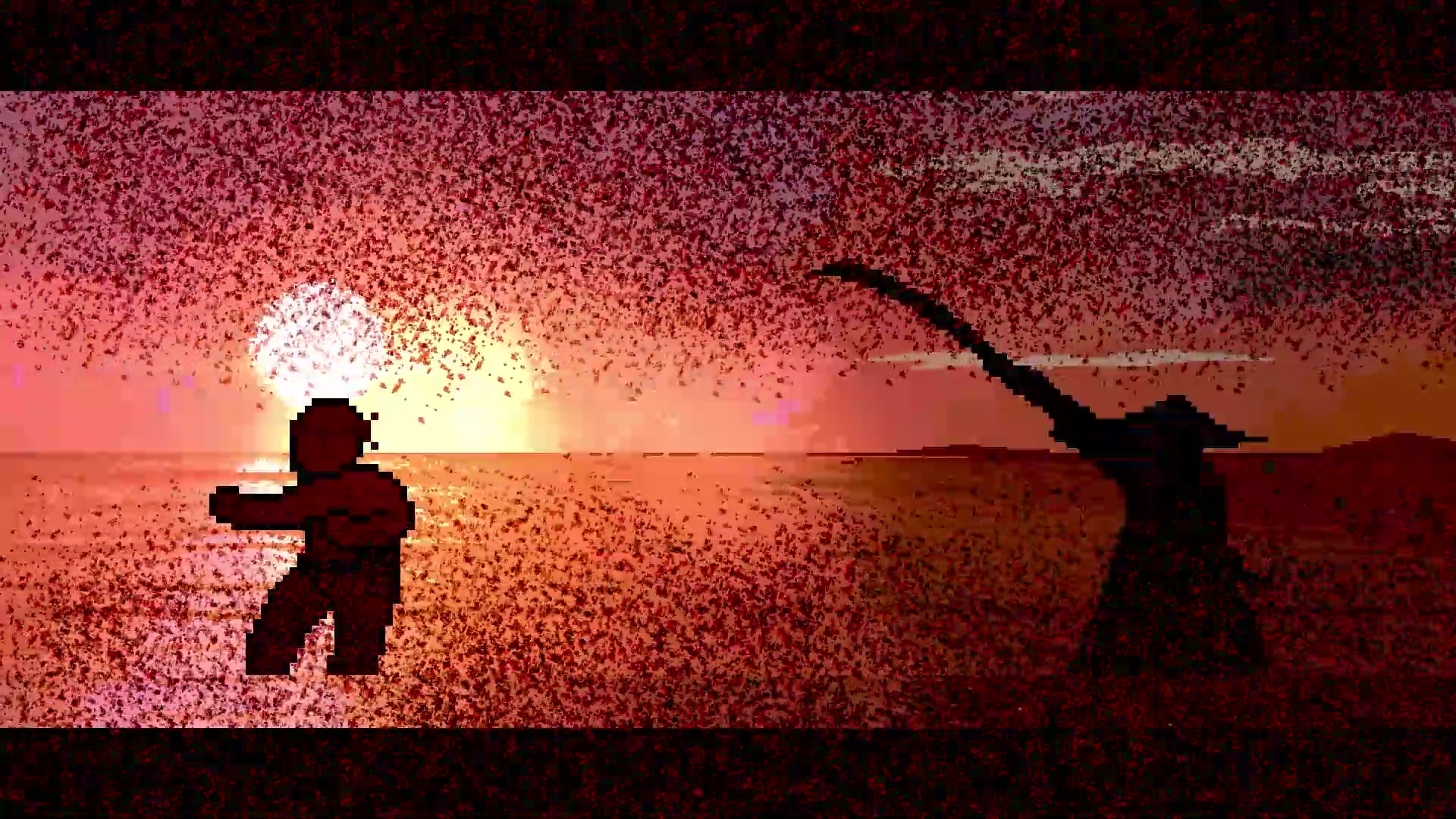
- The blood VFX was difficult–very difficult. However, since I spent so much time already playing around with particles, I pulled it off. For example, that wave crashing VFX from earlier? The double-particles then directly inspired me to give this bloodspray two separate particles.
- What if I told you that this would not remain my proudest work?
- There is one thing left to show you… super but first, I want to say,
- The topic of “Art” is a good place to leave this video. I put a lot of myself into this game, for nothing in return, so it feels rewarding to see my improvement.
- A LOT has happened in my life lately–and not for the better. Yet, through it all, Right of Way still remains itself. It is just a culmination of everything I love. A year ago, I created the entire fencer character because I was so inspired by fencing. A year later, I created the entire Musashi character because I was so inspired by samurai movies. They’re a bit silly, but that’s all my game really is, isn’t it?
- Well…
- Samurai movies are a good way to think about my game.
- It can be a bit silly, but it also can be… a bit… cinematic.
- super attack